Welcome to the portal for museum directors, curators, and technical administrators. MOSTRAmi does not ask visitors to configure an app: the museum can prepare packs, routes, maps, and curatorial context, while Clio guides the visit with scanning, voice, and visible sources.
Unlike traditional apps that depend entirely on expensive cloud servers or give museums little control over visitor privacy, MOSTRAmi introduces a hybrid, consent-aware philosophy of cultural integration.
Artwork photos are not retained by default. Local Face Obfuscation can blur bystanders before any cloud-enabled analysis, and museums can configure privacy-first local mode or consent-gated cloud mode depending on policy.
Gemma can run locally via mobile hardware acceleration (LiteRT-LM), while Gemini Cloud and Clio Live are used only when the visitor or museum chooses the higher-quality cloud path. This keeps baseline costs low and makes cloud usage measurable.
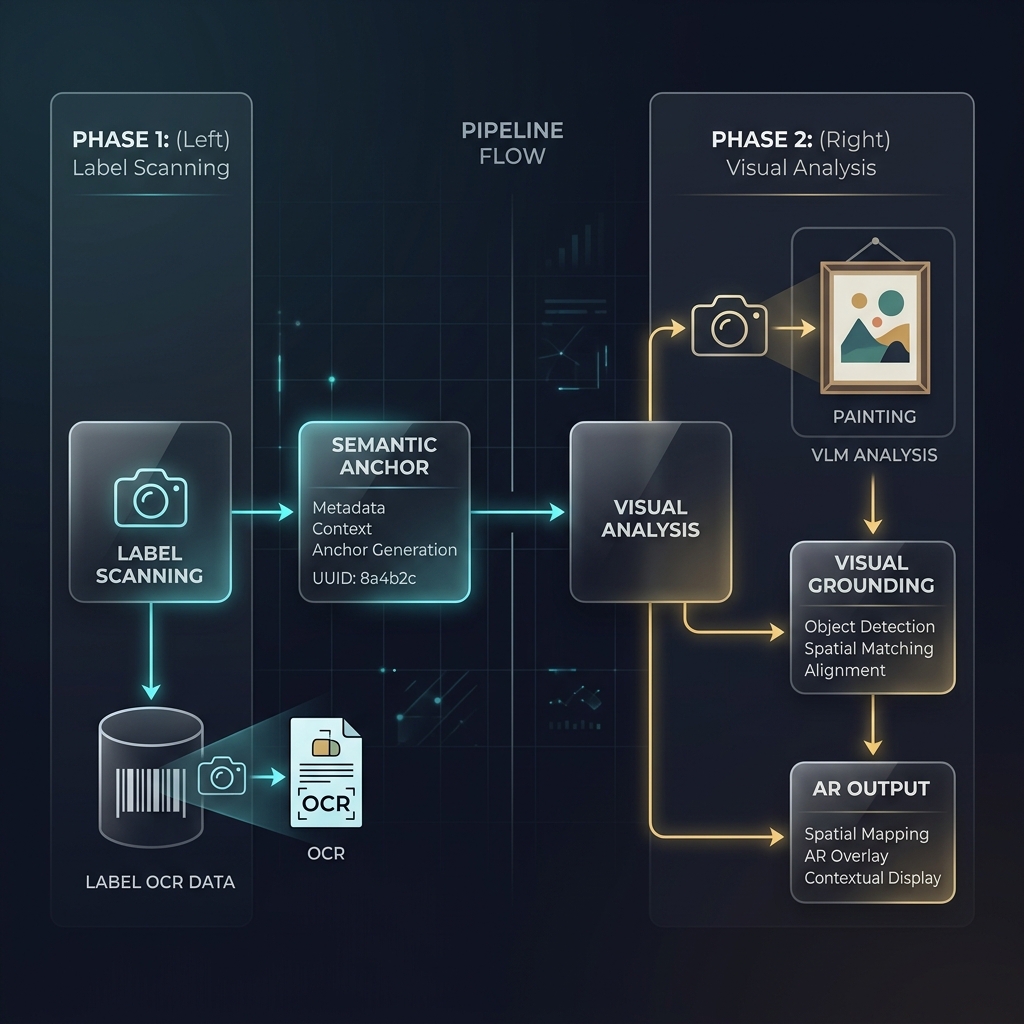
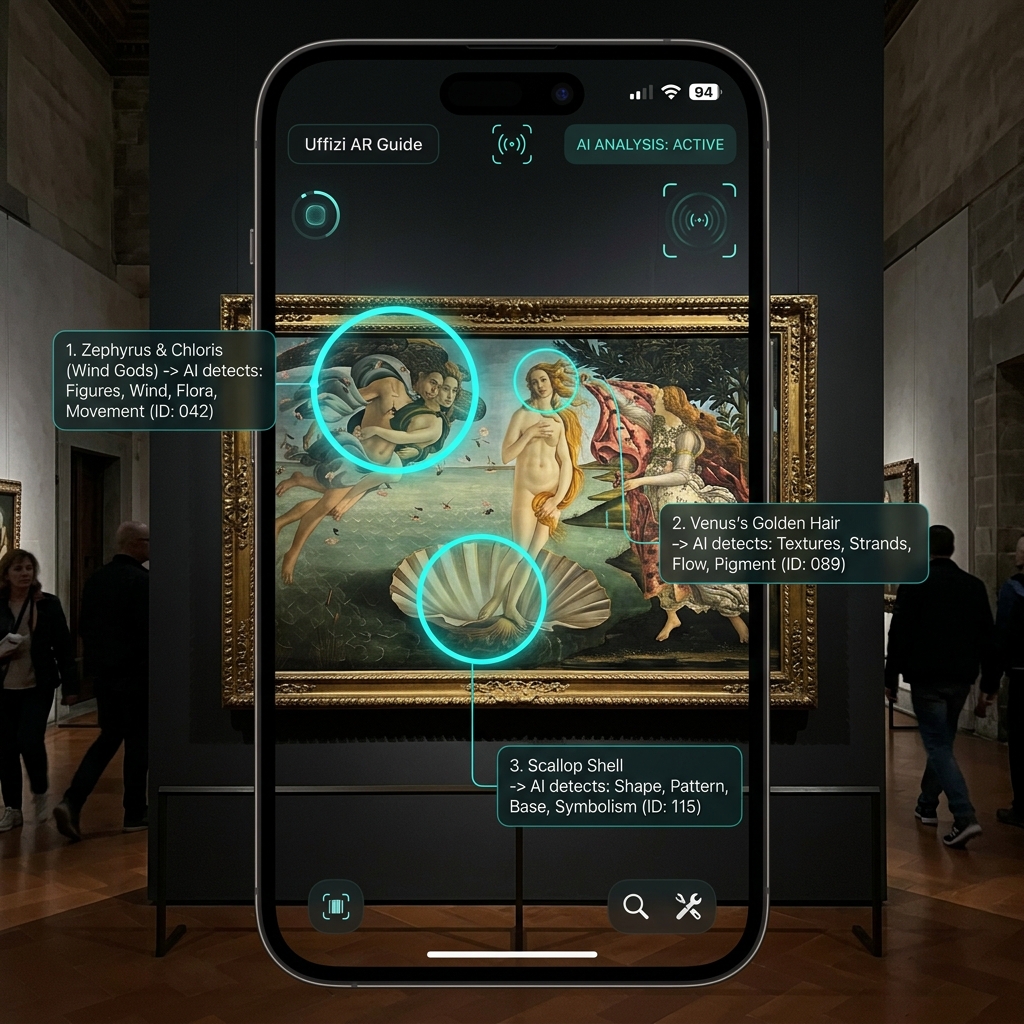
MOSTRAmi can ground responses in Museum Packs, critic datasets, and the MOSTRAmi knowledge base. In chat, source chips and grounding labels show visitors which evidence informed a response, reducing unsupported claims and improving curator oversight.
Each institution can offer routes for families, first-time visitors, scholars, or temporary exhibitions. The pack creates an active visit, defines the artworks to find, and sends the visitor directly to scanning instead of technical menus.
The new Museums & Guided Visits section lets institutions provide loadable packs: not only maps, but routes, artworks, audience, duration, and context for Clio.
A short route for visitors with limited time who want to understand the key works quickly.
A slower visit with historical context, specialist language, and deeper interpretation.
The museum can prepare a pack for a room or seasonal exhibition without recompiling the app experience.
Here is the detailed checklist with the physical and logical requirements to launch the MOSTRAmi experience in your museum rooms.
Small Bluetooth Low Energy (BLE) transmitters are the heart of spatial positioning.
A structured file that couples each BLE beacon with its corresponding artwork.
Planimetries of the rooms in vector format, used to compute graphics positioning.
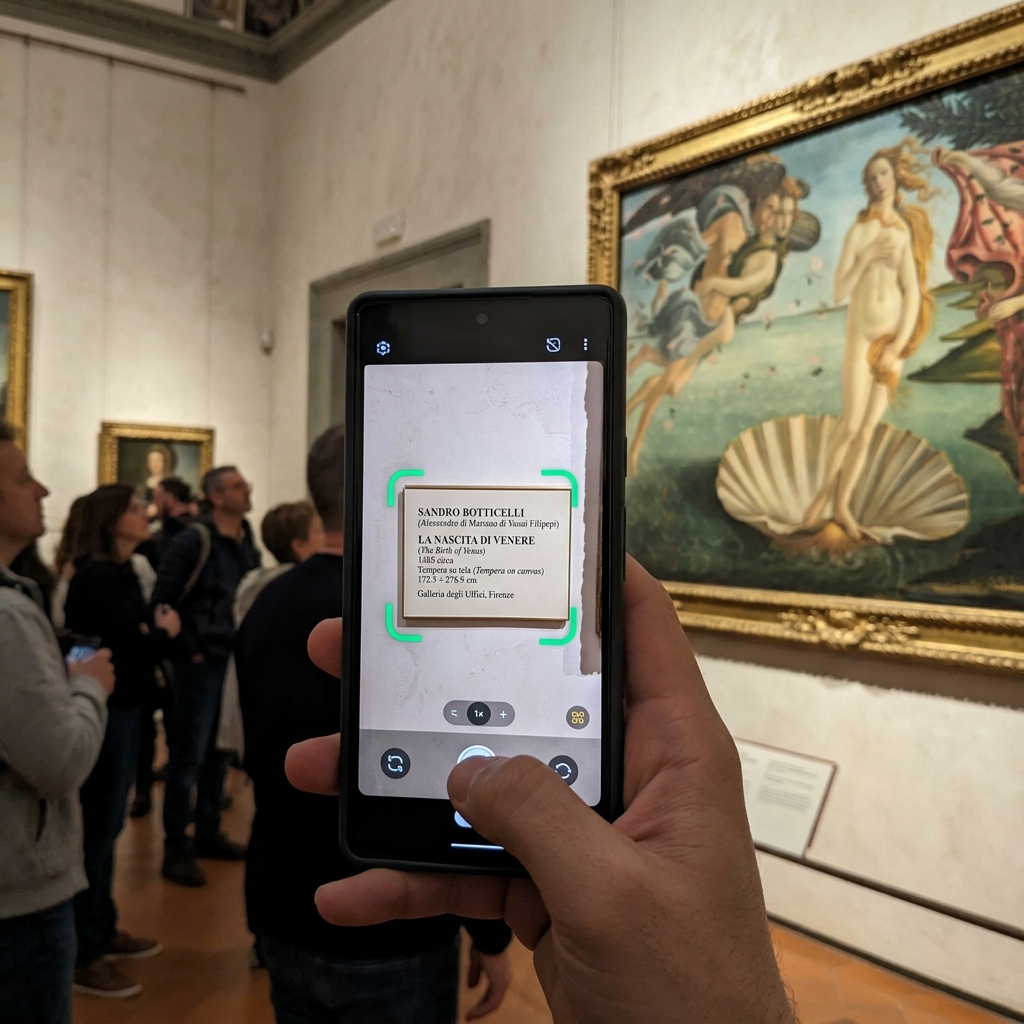
The app scans labels or QR codes to trigger the recognition engines instantly.
A curatorial file that describes the route and lets the app create a structured visit.
Click on the artworks or use the control buttons on the left panel to simulate visitor movement in the room. The telemetry system tracks BLE beacon signals, filters them with Kalman filters, and Clio AI generates narratives in the selected style on the simulated phone on the right!
Sandro Botticelli (1485)
Sandro Botticelli (1482)
Leonardo da Vinci (1472)
You are in front of Sandro Botticelli's Birth of Venus (c. 1485). Philological analysis highlights the neoplatonic harmony of the figure emerging from the waters, evoking a pure spiritual beauty. Would you like to explore the cultural influence of the Medici court?
To map an artwork to a BLE Beacon, simply upload a structured JSON file like this one to the museum's assets. The app's IndoorLocationManager module reads it dynamically upon entering the room.
{
"museum": "Uffizi Gallery",
"room": "Botticelli/Leonardo (Room 1)",
"simulated": true,
"beacons": [
{"id": "beacon_a", "major": 10, "minor": 101, "x": 0.0, "y": 0.0, "txPower": -59},
{"id": "beacon_b", "major": 10, "minor": 102, "x": 8.0, "y": 0.0, "txPower": -59},
{"id": "beacon_c", "major": 10, "minor": 103, "x": 4.0, "y": 7.0, "txPower": -59}
],
"artworks": [
{
"artworkId": 1,
"title": "Birth of Venus",
"artist": "Sandro Botticelli",
"x": 4.0,
"y": 1.0,
"description": "You are in front of Sandro Botticelli's Birth of Venus (c. 1485)..."
},
{
"artworkId": 2,
"title": "Primavera",
"artist": "Sandro Botticelli",
"x": 1.0,
"y": 4.0,
"description": "You are in front of Sandro Botticelli's Primavera (c. 1482)..."
},
{
"artworkId": 3,
"title": "Annunciation",
"artist": "Leonardo da Vinci",
"x": 7.0,
"y": 4.0,
"description": "You are in front of Leonardo da Vinci's Annunciation (c. 1472)..."
}
]
}
The commercial launch of MOSTRAmi features a solid 2-year R&D plan (2026-2027) paired with CAPEX budgeting to build proprietary long-term assets.
Based on the 2026-2027 R&D storiographical and financial plan
| Expense Category | Technological Asset / Service | Units / Duration | Total Cost (€) |
|---|---|---|---|
| Software R&D | Gemma 4 Local Model Optimization (LiteRT) | 6 Months | €30,000 |
| Software R&D | BLE Tracking Algorithm with Kalman Filtering | 12 Months | €45,000 |
| Software R&D | Local Anonymization Engine (Face Blurring via ML Kit) | 6 Months | €20,000 |
| Physical Hardware | Long-Range IP67 iBeacon BLE Beacons (4-Year Battery) | 300 Beacons | €7,500 |
| Deployment | Illustrative Physical Setup and Map Calibration Scenario | 5 modeled museums · 0 committed | €15,000 |
| Intellectual Property | Patent 1: Hybrid local OCR-VLM semantic anchoring | Filing & Legal | €12,000 |
| Intellectual Property | Patent 2: Proximity audio sync via BLE mesh | Filing & Legal | €10,000 |
| Compliance | EU AI Act (Art. 50) & GDPR privacy audits | Certification | €18,000 |
| TOTAL INVESTMENT | €157,500 | ||
The plan begins with invite-only Android testing only after signing, cloud canary and exact-device gates are green. Public distribution and platform expansion follow evidence, not fixed marketing dates.
Invite-only Android testing of scanning, multilingual voice, interruption, latency, crashes and device behavior.
Gradually widen the cohort and device matrix, harden support and complete a production-shaped museum pack.
Run one scoped deployment with agreed content rights, visitor metrics, support process and commercial terms.
Use beta and PoC evidence to decide on an open beta, a limited Play release and the first paid museum offer.
The patent on hybrid local OCR-VLM semantic anchoring shields our proprietary on-device architecture from simple cloud reproductions.
A future independent legal and technical readiness review could reduce regulatory risk. MOSTRAmi does not currently claim EU AI Act certification.
The beacons purchased in CAPEX are reusable for temporary layouts and new educational pathways for years.
We are defining one evidence-gated proof of concept. BLE calibration and vector mapping are optional scope items that require a written venue agreement, budget and technical survey; no museum pilot is presented as committed today.